Information is everywhere.
Insight is not.
AI has accelerated an explosion of content. Every organisation is now publishing. Every leader has a point of view. Every brand is trying to be visible.
And yet, despite this abundance, something isn’t working.
Audiences are increasingly sceptical.
Decision-makers are overwhelmed.
And traditional corporate messaging struggles to cut through.
In this environment, simply “creating content” is no longer enough. Visibility does not equal influence. And expertise alone does not guarantee authority.
This is where thought leadership is often misunderstood.
The Problem Isn’t Expertise
Most organisations don’t lack knowledge. They don’t lack experience. They don’t lack intelligent people with valuable perspectives.
What they lack is structure.
Between expertise and influence lies a gap and it is here that most thought leadership efforts break down.
This gap often shows up in familiar ways:
- Ideas that feel unfocused or difficult to articulate
- Content that lacks consistency or direction
- Messaging that feels overly corporate and disconnected
- Efforts that produce activity, but not impact
The result is predictable: more content, less credibility.
Thought Leadership Is Not About Saying More
It’s about saying what matters clearly.
Effective thought leadership helps people understand change.
It helps stakeholders interpret complexity.
It positions organisations not just as knowledgeable, but as useful.
And usefulness builds trust.
But that only happens when insight is structured in a way that others can follow, engage with and apply.
Where Most Organisations Go Wrong
The default approach is to jump straight into content creation.
Write the article.
Record the video.
Post on LinkedIn.
But without a clear narrative, content becomes fragmented. It may sound intelligent, but it lacks cohesion. It doesn’t build momentum. And it rarely compounds over time.
Strong thought leadership doesn’t start with content.
It starts with clarity.
A More Effective Approach
The organisations that succeed in this space do something different.
They take the time to define:
- What is actually changing in their industry
- What they understand that others may not
- Why that insight matters to their audience
From there, content becomes an extension of thinking — not a substitute for it.
This shift is subtle, but powerful.
Instead of producing content for visibility, they build a system for influence.
From Content to Influence
When thought leadership is approached strategically, it stops being a once-off activity and becomes an ongoing capability.
Ideas are expressed consistently across formats.
Conversations are used to surface deeper insight.
Distribution is intentional, not sporadic.
And success is measured not just by attention but by trust.
Over time, this creates something far more valuable than reach.
It creates credibility.
If You’re Trying to Build Thought Leadership, This Matters
Because the challenge is no longer access to platforms or ability to publish.
The challenge is earning attention in a space where everyone is already speaking.
And in that environment, clarity becomes a competitive advantage.
A Practical Framework
If you’re currently investing in content but not seeing the level of traction, engagement, or influence you expected, the issue is rarely effort.
It’s structure.
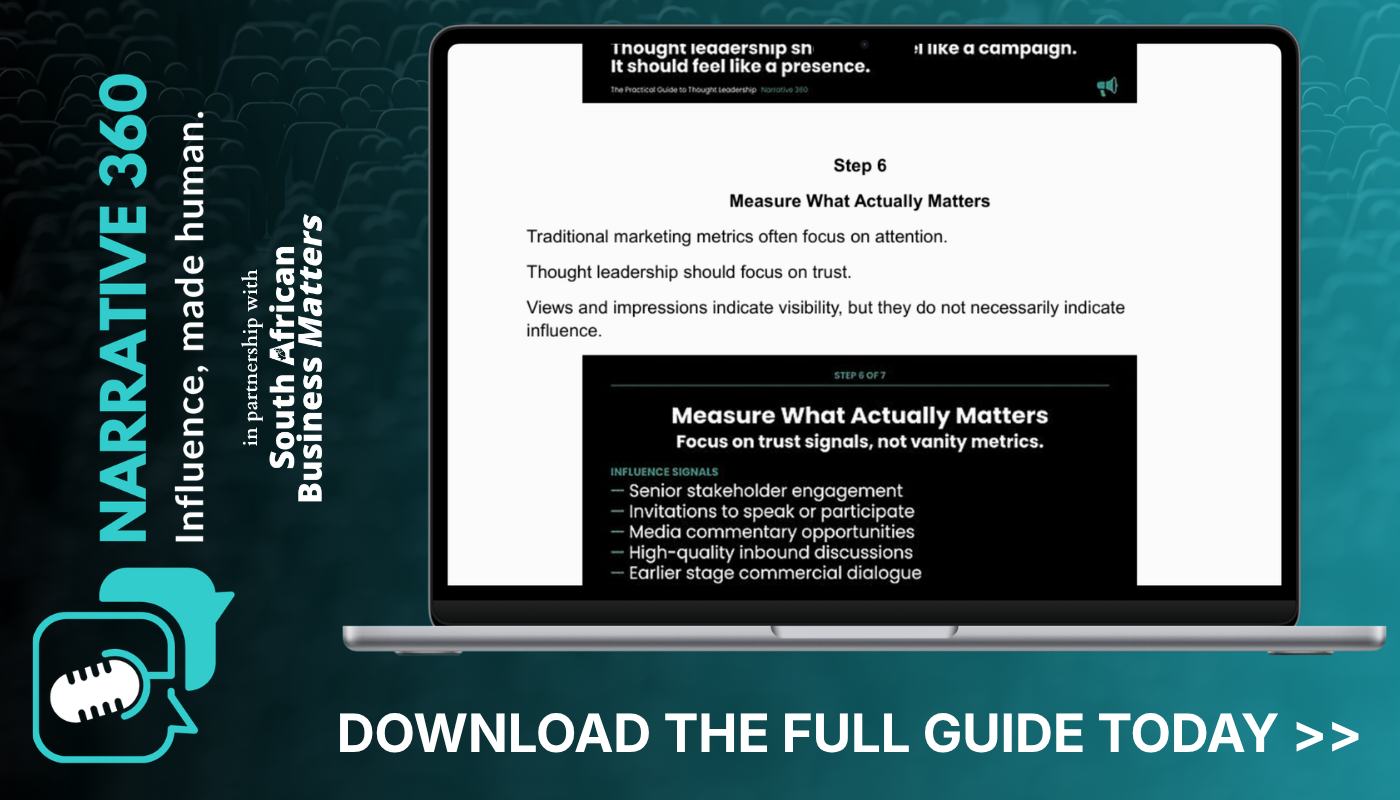
We’ve put together a practical guide that breaks down how to move from expertise to influence — including the frameworks, thinking, and approach we use when working with organisations.